
Quick answer
- Both silk and satin bonnets protect curly hair better than a cotton pillowcase
- Satin is the better everyday choice for most curl types — it is non-absorbent, vegan, affordable, and machine washable
- Silk is a natural fibre; satin is a weave — usually made from polyester
- Silk is more breathable and suits sensitive scalps or those who prefer natural fibres
- Construction matters as much as material — look for large size, wide elastic, and a double layer
- A satin pillowcase makes a great companion to your bonnet — many people find using both together works best
Jump to a section
- What is a satin bonnet?
- What is a silk bonnet?
- What is the difference between silk and satin?
- What are the hair benefits of silk and satin bonnets?
- What is actually different between them?
- Silk vs satin — quick comparison table
- Which is better for curly hair specifically?
- Does how it's made matter as much as the material?
- How to choose the right bonnet size for your hair
- What about a silk or satin pillowcase for curly hair?
- Summary
- Frequently asked questions
The short answer: Both protect your curls better than a cotton pillowcase. But for most people with curly, coily, or wavy hair, a high-quality satin bonnet is the better everyday choice. It is more affordable, easier to care for, completely vegan, and it does not absorb moisture from your hair the way silk can. If you want to wake up with defined, frizz-free curls without spending a fortune or hand-washing your bonnet every few days, satin is your answer.
What is a satin bonnet?
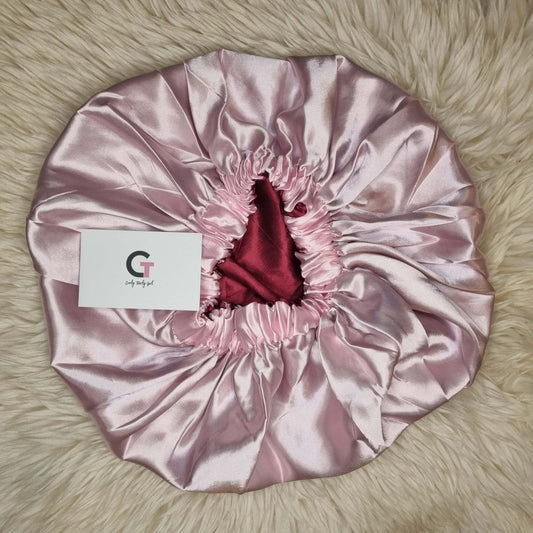
A satin bonnet is a hair covering made from a satin weave, worn overnight to cut down on friction, keep moisture locked in, and protect your curl pattern while you sleep. Most satin bonnets on the market, including ours, are woven from polyester. That is not a compromise. Polyester satin copes with regular machine washing, costs a fraction of real silk, and is completely vegan.
What is a silk bonnet?
A silk bonnet is made from genuine silk, a natural protein fibre spun by silkworms. Quality silk for hair and bedding products is graded by momme weight, usually somewhere between 19 and 25 momme for a solid balance of durability and softness. As a rough guide, that sits in similar territory to a 600 to 900 thread count cotton equivalent. Grade 6A is the highest grade of silk available. Genuine silk is not vegan, and it needs hand washing or a delicate cycle to stay in good condition.
What is the difference between silk and satin?
The key difference between silk and satin is that silk is a natural fibre produced by silkworms, while satin is a type of weave — not a fibre at all. Satin is most commonly made from polyester, which gives it a smooth, glossy finish similar to silk but at a much lower cost. Both feel soft and slippery to the touch, which is why they are so often confused, but they are fundamentally different things.
Silk is produced by silkworms and has been prized for centuries for its smooth texture, breathability, and natural protein structure. The most commonly used type in hair accessories is mulberry silk. Because it comes from silkworms, silk is not vegan.
Satin describes the way threads are woven together — threads float over multiple others to create that characteristic smooth, lustrous surface. High-quality satin is most commonly made from polyester, giving it the same silky feel at a fraction of the cost and without any animal involvement.
This distinction matters more than most people realise. When you see a "silk bonnet" on the shelf, always check the label. Many products marketed as silk are actually polyester satin. A genuine silk bonnet costs significantly more and requires delicate hand-washing. A quality satin bonnet offers comparable protection, lasts just as long with normal washing, and is 100% vegan.
What are the hair benefits of silk and satin bonnets?
The hair benefits of both silk and satin bonnets come from the same core principle: replacing rough, absorbent cotton with a smooth, low-friction surface. Cotton fibres rough up the hair cuticle as you sleep, absorb moisture from your strands, and pull out any products you have applied — leaving curls frizzy, dry, and tangled by morning. Silk and satin both eliminate that problem.
The hair benefits of wearing a silk or satin bonnet include:
- Reduced friction so your curls glide rather than snag
- Moisture retention — neither material pulls hydration from your hair the way cotton does
- Curl pattern protection — your shape is preserved rather than crushed or disrupted overnight
- Fewer wash days — hair stays fresher for longer
- Less breakage and fewer split ends caused by nighttime friction
If you are currently sleeping on a cotton pillowcase with nothing protecting your curls, switching to either a silk or satin bonnet will make a noticeable difference from the very first night.
So what is actually different between them?
Moisture retention
This is where satin has a genuine edge for curly hair. Curly and coily hair is naturally drier than straight hair because natural oils from the scalp have a harder time travelling down a curved hair shaft. Moisture retention is everything.
Silk, as a natural protein fibre, has some moisture-wicking properties. It can draw a small amount of hydration from your hair as you sleep — something that matters more for curly hair than any other texture.
High-quality polyester satin does not absorb moisture at all. It simply keeps whatever hydration is in your hair exactly where it belongs. For curls that are already prone to dryness, that is a meaningful difference.
Breathability
Silk is more breathable than synthetic satin. It regulates temperature naturally and is hypoallergenic, making it a good option for those with sensitive scalps or anyone who runs hot in their sleep.
Most satin bonnets are less breathable than silk. That said, a double-layered satin bonnet worn loosely causes very little discomfort for most sleepers — you are unlikely to notice the difference unless you have a particularly warm or sensitive scalp.
Price
A genuine mulberry silk bonnet typically costs two to five times more than a quality satin bonnet. Silk also requires more careful laundering — hand washing with a gentle detergent, no tumble drying.
A satin bonnet can go in the washing machine on a gentle cycle and air dry in an hour. For something you will use every single night, that ease of care is worth considering.
Vegan and cruelty-free
Silk is not vegan. It is produced by silkworms, and large-scale silk production is not cruelty-free. If that matters to you — and for many people it does — satin is the clear choice. All Curly Twirly Girl bonnets are 100% vegan.
Durability
A well-made satin bonnet holds up very well with regular use. Our double-layered reversible bonnets are designed to keep their shape and smoothness wash after wash. Silk bonnets, while beautiful, are more delicate and can wear more quickly if not carefully maintained.
Silk vs satin bonnet — quick comparison
| Satin bonnet | Silk bonnet | |
|---|---|---|
| Moisture retention | Excellent — non-absorbent | Very good — slight wicking |
| Friction reduction | Excellent | Excellent |
| Frizz reduction | Excellent | Excellent |
| Breathability | Good | Very good |
| Durability | Very durable — holds up to regular machine washing | Delicate — can snag or pill with frequent washing |
| Price | $20–$34 (£15–£25) for a quality satin bonnet | $47–$81+ (£35–£60+) for genuine silk |
| Care | Machine washable | Hand wash only |
| Vegan | Yes | No |
| Best for | Most curl types, everyday use | Sensitive scalps, preference for natural fibres |
Every Curly Twirly Girl bonnet is 100% vegan, cruelty-free, and made by a black-owned brand, no compromise on ethics or on your curls.
Shop Satin Bonnet
Which is better for curly hair specifically?
For curly, coily, and wavy hair, satin is the better everyday choice for most people — and the reason comes back to moisture.
Curly hair needs hydration above everything else. Satin's non-absorbent surface means your leave-in conditioner, curl cream, or overnight oil treatment stays in your hair rather than transferring to your bonnet. You wake up with softer, more defined curls.
Silk can be slightly better for breathability and temperature regulation, and it is a genuinely premium material. But for the specific job of protecting curls overnight, high-quality satin performs just as well. The gap in performance is far smaller than the gap in price.
If you have an extremely sensitive scalp, run very hot in your sleep, or simply prefer natural fibres regardless of cost, a good silk bonnet is a worthwhile investment. But for most people with curly hair, a quality satin bonnet gives you everything you need.
Does how it's made matter as much as the material?
Yes — and this is important. A cheap, thin satin bonnet that slips off in the night protects your curls less than a well-made silk bonnet that stays on. The material matters, but so does the quality of how the bonnet is put together.
When choosing a bonnet — whether silk or satin — look for:
- Large size — your hair needs room inside without being compressed or kinked
- Soft, wide elastic — should stay on all night without digging into your hairline or nape
- Double-layered construction — more durable, better at maintaining shape with regular washing
- Smooth interior — run your hand inside; it should feel completely smooth with no rough seams
- Vegan materials — if that matters to you, always check the label before buying
How to choose the right bonnet size for your hair
How it's made matters just as much as material. A well-made large satin bonnet will outperform a poorly fitted silk one every time.
| Hair type or style | Recommended size | Why |
|---|---|---|
| Short hair | Standard | Full coverage without excess fabric bunching at the back |
| Medium length curls | Large / oversized | Gives curls room to sit loosely without being compressed against the scalp |
| Long hair | Oversized | Stops flattening and frizz at the roots over longer lengths |
| Braids / locs | Oversized, wide elastic | Needs the most room and the most secure fit. Standard bonnets are the most likely to slip off with this volume |
Whatever your hair type, look for a wide, soft elastic band. It should hold the bonnet in place all night without digging into your hairline or nape.
Found your size? Our large reversible satin bonnet comes in four colours, built to fit every curl type comfortably from the first night.
Shop Satin Bonnet
What about a silk or satin pillowcase for curly hair?
A silk or satin pillowcase is one of the most popular alternatives to a bonnet — and a genuinely good option for curly hair. Like a bonnet, both silk and satin pillowcases protect your curls from the friction and moisture absorption of cotton. Many people find that swapping to a satin pillowcase alone makes a noticeable difference to how their hair looks in the morning.
The main difference is coverage. A bonnet moves with your hair all night, so your curls stay protected however you sleep. A pillowcase protects you as long as your head stays on it — if you move around a lot, your hair can end up off the smooth surface and back onto cotton.
That said, plenty of people use both together, and it is a great combination. If your bonnet ever shifts in the night, a satin pillowcase means your hair still lands on a smooth, low-friction surface rather than rough cotton.
Whether you choose a bonnet, a pillowcase, or both really comes down to personal preference. Some people find bonnets uncomfortable or too warm; others love the security of knowing every strand is covered. There is no single right answer — the best choice is whatever you will actually use consistently.
What both options agree on: either is significantly better for curly hair than a standard cotton pillowcase.
Summary
Key takeaways
- Satin does not absorb moisture — this is the single biggest reason it edges out silk for most curly hair types, as hydration stays in your hair not your bonnet
- Silk has the breathability advantage — if you run hot at night or have a sensitive scalp, it is worth the extra cost
- The label can be misleading — many products sold as "silk" bonnets are actually polyester satin, so always check before you buy
- A cheap bonnet in either material will underperform a well-made one — double-layered construction, wide elastic, and a smooth interior matter more than the price tag
- Bonnet or pillowcase? Both work well and work even better together — there is no wrong answer, just whatever suits your sleep style
- The FAQ section below covers the most common questions in full if you want a quick answer on a specific point
Ready to protect your curls overnight? Explore our range of vegan reversible satin bonnets — large enough for all curl types and built to last wash after wash.
Frequently asked questions
Is silk or satin better for curly hair?
For most people with curly hair, satin is the better everyday choice. High-quality polyester satin does not absorb moisture, which means your leave-in conditioner and curl products stay in your hair overnight rather than transferring to your bonnet. Satin is also more affordable, machine washable, and 100% vegan. Silk is a premium option that performs well — particularly for those with sensitive scalps or a preference for natural fibres — but for everyday curl protection, satin delivers everything you need at a much lower price point.
What is the difference between a silk and satin bonnet?
Silk is a natural fibre produced by silkworms, while satin is a type of weave — most commonly made from polyester. Both have a smooth, low-friction surface that protects hair overnight, but they are fundamentally different materials. Silk is breathable, hypoallergenic, and naturally temperature-regulating. Satin is non-absorbent, more durable with regular washing, and significantly more affordable. Many bonnets labelled as "silk" are actually polyester satin, so always check the label before buying.
Is satin good for curly hair?
Yes — satin is excellent for curly hair. Its smooth surface reduces friction between your hair and your pillow, which prevents frizz, minimises breakage, and preserves your curl pattern overnight. Crucially, satin does not absorb moisture, so your hair retains its natural hydration and any products you have applied. For curly hair, which is naturally prone to dryness, this makes a real difference to how your curls look and feel in the morning.
Is a silk or satin bonnet better?
Both work well — the better choice depends on your priorities. Satin is better for most people: it is non-absorbent, affordable, easy to care for, and vegan. Silk is better if you have a sensitive scalp, prefer natural fibres, or run very warm in your sleep. In terms of protecting your curl pattern and reducing friction, both materials perform at a similar level. The biggest practical differences are price, care requirements, and the fact that silk is not vegan.
Can I use a pillowcase instead of a bonnet?
Yes — a silk or satin pillowcase is a good option for protecting curly hair overnight and many people use one happily. The main difference is that a bonnet moves with your hair all night, so every strand stays covered however you sleep. A pillowcase only protects your hair while your head is resting on it. If you move around a lot during sleep, your hair can end up off the smooth surface. Many people find using both together — a bonnet plus a satin pillowcase as backup — gives the best results. Ultimately it comes down to personal preference and what you find most comfortable.
Does a satin bonnet stop frizz?
Yes. Frizz is largely caused by friction — when your hair rubs against rough cotton fibres as you move in your sleep, it roughens the hair cuticle and causes that halo of frizz in the morning. A satin bonnet eliminates that friction by creating a smooth surface for your hair to glide against. It also prevents moisture loss overnight, which is another key cause of frizz in curly and coily hair. Most people notice a significant reduction in morning frizz from the very first night they use one.
Is satin the same as silk?
No. Silk is a natural fibre produced by silkworms. Satin is a weave, most often made from polyester. They can look alike, but they are fundamentally different materials with different care needs, different price points, and different vegan status.
Is satin polyester?
Most satin used in bonnets, including ours, is polyester. That gives it a smooth, silk-like finish while keeping it affordable, durable, and fully vegan.
Is a satin bonnet bad for your hair?
No, not when it fits properly. A well-sized satin bonnet reduces friction and protects moisture. Problems only come from a poorly made or badly fitted bonnet that slips off or has a rough interior seam.
Is satin or silk better for hair growth?
Neither material grows hair directly. What both do is cut down breakage caused by nighttime friction, which helps you keep the length you already have. Satin does this job just as well as silk for most curl types.
Which is better for hot sleepers, silk or satin?
Silk is more breathable and the better pick if you run warm overnight. A double-layered satin bonnet worn loosely is a comfortable middle ground for most people, but if you sleep hot and have a sensitive scalp, silk is worth the extra cost.
Related reading:
7 Benefits of Satin Bonnets for Curly Hair
Can You Wear a Satin Bonnet with Straight Hair?
How to Sleep with Curly Hair
Best bonnets for Curly Hair
Best Hair Bonnets for Natural Hair
Best Black-owned Satin Bonnets